Monday, September 6, 2010
The Innovators 1950-1960: Diving The Real
I found this article very interesting. It is very interesting to think of someone using the real as an artform. It seems crazy that today cinema has gone so far from the real and from Bazin's thoughts of what cinema should be. When reading this article I could not help to think of reality t.v. and how it is supposed to be "real" but is it? This article really made me re-think some things such as what is "real"? I feel as though Bazin really had something going for him when talking about what was real and how cinema should be real-life with a little help. I thoroughly enjoyed the part in the article that spoke about the camera and film and how a photograph is organic and seems to be a part of nature rather than mechanical. I found this to be a great article that really got me thinking.

Wednesday, September 1, 2010
Ch 1 Activity, Transitions
Transitions occur throughout every movie to move from one scene into another. A transition is meant to interrupt the flow of the movie as little as possible and continue the pace of what is occurring. Fades tend to allow a scene to be drawn out, where as cuts end a scene and transition into the next as quickly as possible.
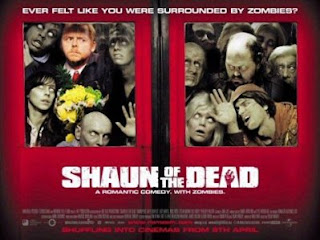 Throughout much of the movie "Shaun of the Dead", director Edgar Wright creates quick transitions between scenes through a series of very short cuts of minor actions a character may do. For example, as a transition to show the characters moving from the inside of Shaun's house to the neighborhood outside, many cuts are made to Shaun brushing his teeth, putting the toothbrush down, and washing his hands. Each cut lasts only a second, but continues the pace of the movie from one scene to the next.
 Throughout much of the movie "Shaun of the Dead", director Edgar Wright creates quick transitions between scenes through a series of very short cuts of minor actions a character may do. For example, as a transition to show the characters moving from the inside of Shaun's house to the neighborhood outside, many cuts are made to Shaun brushing his teeth, putting the toothbrush down, and washing his hands. Each cut lasts only a second, but continues the pace of the movie from one scene to the next.
Chapter 1 Exercise

The movie I decided to re-watch was Inception. Even when I watched it the first time I thought it had such great cinematography with their amazing special effects, but after the second time I realized what great camera shots they had with just using the basic techniques in the movie. They used montage quite often throughout the movie (flashing back to various of the same scenes in Cobb's memory that he wanted to change; sometimes with just music & sometimes with the memory's sounds). A few examples include what looked like they used a dolly (while following the characters around Ariadne's first dream city), panning (to show the dream worlds when they arrived), and extreme close-ups (to show the character's emotionless faces while they were put on the machines during the dream & also right when they awoke from the dreams). This movie definitely has great camera work worth watching.
Chapter 1 Excercise

I decided to re watch a movie I've seen probably a million times...and a million times again with commentary. (500) Days of Summer has some great example of montages. This can be seen in the very first part of the movie when you see a side by side montage of Tom and Summer growing up. It also incorporates music from Regina Spektor (awesome soundtrack) which is typical of montage. They also use montage to show how Tom feels about Summer, when he loves everything about her, when he hates those same things. These flashback montages have great examples of various closeup styles.
Ch. 1 activity
The activity I chose to do was visit an art gallery. I actually visited two galleries today while roaming around campus taking photography, and found myself in the "Sideshow" exhibit in the University Gallery and I also visited the Architecture gallery. They were both very different types of exhibits but they both acted as springboards for ideas in my TBM projects. For example, the Sideshow exhibit had these really huge banners extending all the way to the ceiling, and the way that they took up a whole wall but were still well-lit by the gallery space made me really think about lighting and setting up shots. The architecture gallery was great at showing different angles, points-of-view, and framing techniques through the different images of buildings they showcased.
Ch1 Response, Watch for Close ups
A director can dramatize a shot by making it a close-up or extreme close-up. In extreme close-ups, the focus is entirely on the subject. This can sometimes be used in comedies when the actor produces an odd face or it can make the focused object more important than usual. Once close up, the shot becomes much more hilarious or serious than it would be in a shot that's farther away.
Sometimes shots can be very close at first. Then the same subject would be shot farther to show something in the background that compliments the mood from the first close up.
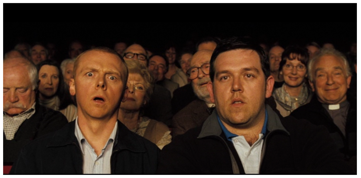 Here's an example from "Hot Fuzz" where we see character Angel's face vs. Everyone-Else.
A shot of the object or a place from afar is usually the establishing shot. In the picture, the boring symmetrical and similar looking audience makes the front characters' faces all the more obvious and humorous. This shot has not only established the setting of a theater but also dramatizes the mood.
Subscribe to:
Posts (Atom)